TagLeadership

The Lost Art of Backward Planning


Jesus had a plan…and he executed it right on time.

As the time approached for him to be taken up to heaven, Jesus resolutely set out for Jerusalem. Luke 9:51 (NIV)

Short of the divine knowledge Jesus possessed, few of us would be able to deliver exactly on time with as far to travel and as many things to do.  Along the way he taught  parables, eased Martha to the better choice, confronted demons, expressed woes to the pharisees, healed people, dined with his disciples, and prayed all night before being arrested…right on time.

Granted, the things we do day-to-day don’t have eternal consequences for all of humanity, but why do we seem to always miss deadlines, cram all night to study or finish a project, or flat out miss deadlines?  We’ve lost the art of backward planning.

Backward planning is the process of determining the right time to start something by subtracting from the finish point the time required to complete it .

Here’s a simple example:  It takes 2 hours to drive to your mothers and you need to be there by 7:00pm.  Subtract 2 hours from 7pm and you need to leave at five.  WAIT, WAIT…don’t stop reading, it gets better.

What we fail to do is apply this simple concept to more complex projects like the yearly report, your  masters degree thesis, or even family panning.   Here’s some simple steps to backward plan your next project.

  1. Determine the finish point
  2. List all tasks that must be done in order
  3. Estimate the length of each task
  4. Subtract each length from the finish point

(more…)

Making a Change at Church: Eight (not so) Simple Steps

In a previous post I quoted John Maxell who observed that  older and “insecure leaders view change as a threat rather than an opportunity. ”  But what if you have to change.

Many small churches are facing declining membership because their traditions have not changed in decades.  The prevailing belief is worship traditions are Biblical and any deviation must certainly be a sin.  Even though largely attracted to the spiritual (review the popular movies today) , younger generations are increasingly turned off by  what they see as rigid and irrelevant. (more…)

Change: Threat or Opportunity?

Nobel Prize-winning author John Steinbeck asserted, ‘It is the nature of man as he grows older to protect against change, particularly change for the better.’ By its very nature, empowerment brings constant change in that it encourages people to grow and innovate. Change is the price of progress. Insecure leaders view change as a threat rather than an opportunity. – John Maxwell

Leading from the Outside

Unless you are prepared to see things differently and go against the current, you are unlikely to accomplish anything truly important. And to go against the current, you have to be something of an outsider, living on the edge, a member of a small but vibrant counterculture.  You must free yourself from habitual ways of looking at things, cultivate an independent and questioning perspective, and be ready to embrace alternative and counterintuitive points of view.

Dove Frohman in Leadership the Hard Way: Why Leadership Can’t Be Taught – And How You Can Learn It Anyway (J-B Warren Bennis Series)

Management Since 1800

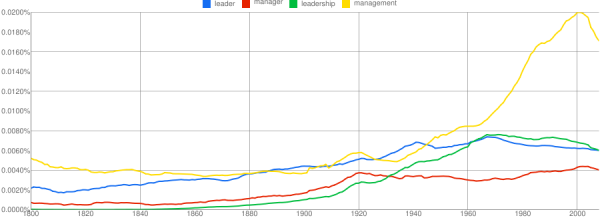
I’m a proponent of leadership over management as the primary course of study to improve one’s ability to influence people.  Management, however, seems to have reigned as a subject in books since the 1800s.  The google Ngram below charts the usage of the keywords “manager,” “leader,” “management”, and “leadership” in books since 1800.

I notice a couple of interesting things about these trends:

  1. Leadership subjects did not appear until the mid 1800s (perhaps as a result of the American Civil War)
  2. Management subjects decreased during the America’s Great Depression
  3. Management subjects skyrocketed during 1970-1990  (the rise in the economies of industrialized countries)
  4. All of the keywords dropped in usage after 2001 (Influenced by the attacks on September 11?)

The Best Executive

The best executive is the one who has sense enough to pick good men to do what he wants done, and self-restraint to keep from meddling with them while they do it. – Theodore Roosevelt

Your Finest Hour

To every man there comes in his lifetime that special moment when he is figuratively tapped on the shoulder and offered a choice to do a very special thing, unique to him and fitted to his talents; what a tragedy if that moment finds him unprepared or unqualified for the work which would be his finest hour

– Sir Winston Churchill