The philosophy of the wise and free mind, the disciplined spirit, and the world made whole by both.
The Creed of Rational Virtuism – Thinking Clearly. Living Well. Caring Deeply.
We hold that Wisdom is the highest faculty of the human spirit; the union of clear thought, disciplined conscience, and lived understanding. Through wisdom, the individual perceives truth, acts with integrity, and stewards creation with purpose. Every person bears the sacred duty to seek wisdom, to test illusion against reality, and to act not by impulse or imitation, but by discernment and understanding. Wisdom demands humility before truth and courage in its defense.
Article I – Wisdom: The Light That Orders the Soul
We affirm that Wisdom is the light of God within the soul, the union of reason and conscience made whole through understanding. Wisdom is not mere knowledge, but the harmony of truth and virtue expressed through action. It guides judgment beyond impulse, aligns thought with reality, and tempers strength with humility. To live wisely is to act with clarity of mind, purity of motive, and reverence for creation. Wisdom requires care of the self, for clarity of mind and endurance of spirit are necessary to think rightly and live well.
Article II – Virtue: The Discipline of Self-Governance
We hold that Virtue is the act of self-governance in harmony with truth, the will to live neither as master nor slave, but as a conscious being accountable for one’s own thought and deed. Virtue demands responsibility, not obedience; discipline, not submission. The righteous man bends his knee to no idol, for his reverence is reserved for truth alone, and his joy springs from the integrity of his own soul. Each person is a rational soul, not a means to another’s end but an end in themselves, an image of God’s reason. To use another merely for gain is to violate the moral law of creation.
Article III – Love: The Ethics of Intelligent Goodwill
We proclaim that Love, in its highest form, is intelligent goodwill; not sentiment nor sacrifice, but the chosen regard for the life and liberty of all creation. He who governs himself through wisdom will not exploit what he tends, for he knows that to destroy what he is responsible for is to wound his own soul. Thus, care is not servitude, but responsibility practiced with wisdom, and in that care is wonder, the quiet amazement that life exists at all.
Article IV – Action: Wisdom, Virtue, and Love Made Visible
We affirm that Action is the proof of Wisdom and the labor of Virtue, and the means by which a rightly ordered life takes form in the world. To live is not merely to preserve, but to create—to shape raw matter, raw thought, raw institutions, and raw circumstance into higher order. Creation is the discipline of the free mind: the craftsman’s hand guided by intellect, the leader’s judgment guided by conscience, the steward’s care made structure. Wise action respects human limits as well as responsibility, recognizing rest and discipline as necessary for faithful and enduring labor. Action gives form to wisdom, but the created order sets the bounds within which all right action must remain.
Article V – The Created Order: The Covenant of People and Earth
We confess that the Created Order is the living order of which we are both part and protector—people and land alike entrusted to our care. It is the given reality within which all human action occurs and by which it must be judged. To work and to keep the Earth is both command and covenant: to cultivate soil and city, field and family, institution and habitat, with equal reverence. The free man does not plunder the world nor abandon his neighbor; he perfects both through the art of understanding. Man’s highest virtue is not the conquest of nature nor the domination of others, but the cultivation of wonder, dignity, and flourishing before them. In every restored landscape, every strengthened community, and every act of wise care, he finds joy renewed and wonder reborn.
Article VI – Stewardship: The Charge of Wise Care
We declare that the virtuous life is one of Stewardship rightly understood: responsibility practiced with wisdom over what God has entrusted to human care—people, places, institutions, and the living Earth. It joins authority with restraint, power with accountability, and freedom with duty. Such care requires attentiveness to rhythm (labor and rest) as part of faithful governance. To live wisely is to live generatively: to restore what is broken in land and life, to preserve what sustains human dignity and natural order, and to build what uplifts the human spirit. This charge is fulfilled neither through domination nor neglect, but through reasoned care, moral courage, and reverent joy. Each act of honest labor, just governance, invention, and restoration is a hymn of stewardship; the visible testament of the inner light and in the doing of it he knows joy, the sacred joy of participation in creation.
Article VII — Freedom: The Liberty of the Self-Governed Soul
We proclaim that true freedom is not license, but self-governance through wisdom. The wise neither bow to the coercion of power nor to the mob’s clamor but stand steadfast in clarity of mind and purity of motive. Freedom is the discipline of the soul that governs itself rightly; the fruit of reason rooted in virtue.
Therefore we vow:
To act with wisdom as our creed and virtue as our law,
To love creation not as possession but as trust,
To guard the sanctity of individual conscience,
To speak truth though the world should rage,
To walk upright in the freedom of God’s reason,
To practice discipline, rest, and renewal so that our care may endure, and
To live in joy and wonder at the gift of existence.
This is Rational Virtuism:
The philosophy of the wise and free mind,
the disciplined spirit,
and the world made whole by both.
Building a Life That Stands in an Age of Noise
We live in a culture that rewards outrage more than understanding and noise more than clarity. I’m motivated to explore antidotes to the current cultural crisis in United States however, I’m sure other nations are facing similar situations. Institutions that once anchored us now trade in slogans of fear because fear (real or manufactured) motivates…too often to extremes. Movements demand blind allegiance but offer little strength in return. And the generations who came before us (despite their virtues) failed to build a foundation sturdy enough to hand down stability, clarity, or a shared understanding of what a grounded life requires.
This is a call to build that foundation for today and tomorrow. In a world like this, we don’t need another ideology to follow. We need a framework strong enough to hold when everything else wavers. A way of living that keeps us steady when trends shift, arguments flare, and certainty is mistaken for truth.
Before we can pursue wisdom, we need bearings—simple, durable principles that orient our choices and shape our character. Not as laws or dogmas, but as commitments we can return to when the world pulls us in every direction at once. Here is the framework, laid bare:
Core Tenets of a Life Oriented Toward Wisdom
— Reality over ideology.
— Reason over reflex.
— Stewardship over consumption.
— Individuality over absorption.
— Conscience over convenience.
— Discernment over outrage.
— Creation over criticism.
— Courage over comfort.
— Integrity over reputation.
— Clarity over conformity.
— Responsibility over blame.
— Order over noise.
— Humility over certainty.
— Action over intention.
— Understanding over judgment.
These aren’t answers they are orientation points. They help us cut through the static and live from a place of internal steadiness rather than cultural momentum. When practiced, they form a kind of moral and intellectual craftsmanship: a way of interpreting the world without being consumed by it.
A life built on wisdom isn’t loud. It isn’t reactive. It isn’t driven by the need to be seen. It is grounded, intentional, and quietly resilient like bedrock beneath shifting sand.
Foundations shape futures.
What Do You Stand On When the Ground Keeps Shifting?
We live in a moment where every headline insists you choose a side, but none of them offer a place to stand. You can feel it: people are angrier, louder, more certain of things they’ve barely examined. You see generations drifting without a sense of direction, pulled by whatever current is strongest that week. And you sense the deeper problem a culture hungry for meaning but allergic to the work required to build it.
So ask yourself: what guides your choices when the noise drowns out your better judgment?
If you’re honest, you know the traditional anchors aren’t holding like they once did. Institutions that once offered clarity now trade in slogans. Politics demands your loyalty but rarely earns your trust. Even religious communities, once sources of solace and moral grounding, often fracture along the same lines of suspicion and intolerance as the culture they are supposed to transcend. People of faith feel cornered; people outside faith feel alienated.
And somewhere in all of this, you are expected to navigate your life with wisdom.
But where are you supposed to learn it?
We tell young people to “be themselves,” but never show them how to build a self “themself” worth being. We tell them to “follow the science,” but never teach them the discipline of thinking. We tell them to “make a difference,” but rarely equip them with the courage or clarity required to act in a world that pushes conformity over conviction.
What results is exactly what you see: generations without direction, individuals without internal ballast, a culture without a shared vocabulary for what a good life even is.
This drift is not caused by a lack of intelligence. It’s caused by a lack of philosophy (love of wisdom). Not the academic kind buried in footnotes, but the lived kind that steadies your hand and sharpens your conscience. A philosophy that helps you interpret the world, discern truth from illusion, and act with integrity rather than impulse. A philosophy marked by critical thinking guided by steadfast principles.
You need something practical. Something grounded. Something that does not demand blind loyalty but invites clear thinking. Something that refuses both the chaos of relativism and the rigidity of dogma. Something that honors individual responsibility while insisting that your life leaves a mark on the world around you.
Most importantly, you need a philosophy that can be practiced — daily, quietly, consistently — in the choices you make, the courage you cultivate, and the stewardship you offer to whatever corner of the world has been entrusted to you.A way of living that belongs to no institution, no party, no faction — only to the individual willing to think, to act, and to grow.
In a culture drifting in every direction at once, clarity is not a luxury.
Clarity is your compass.
More to follow….
Why Walk
“Why walk? It’s the simplest way left to understand scale. On foot, a mile is exactly a mile, not a number. You learn to listen to your breathing, to pace your thirst, to watch for shade the way you’d watch for mercy. The world becomes proportional again. And maybe that’s the beginning of any kind of wisdom—seeing things at their right size.” ChatGPT Edward AI-bbey
The River Between
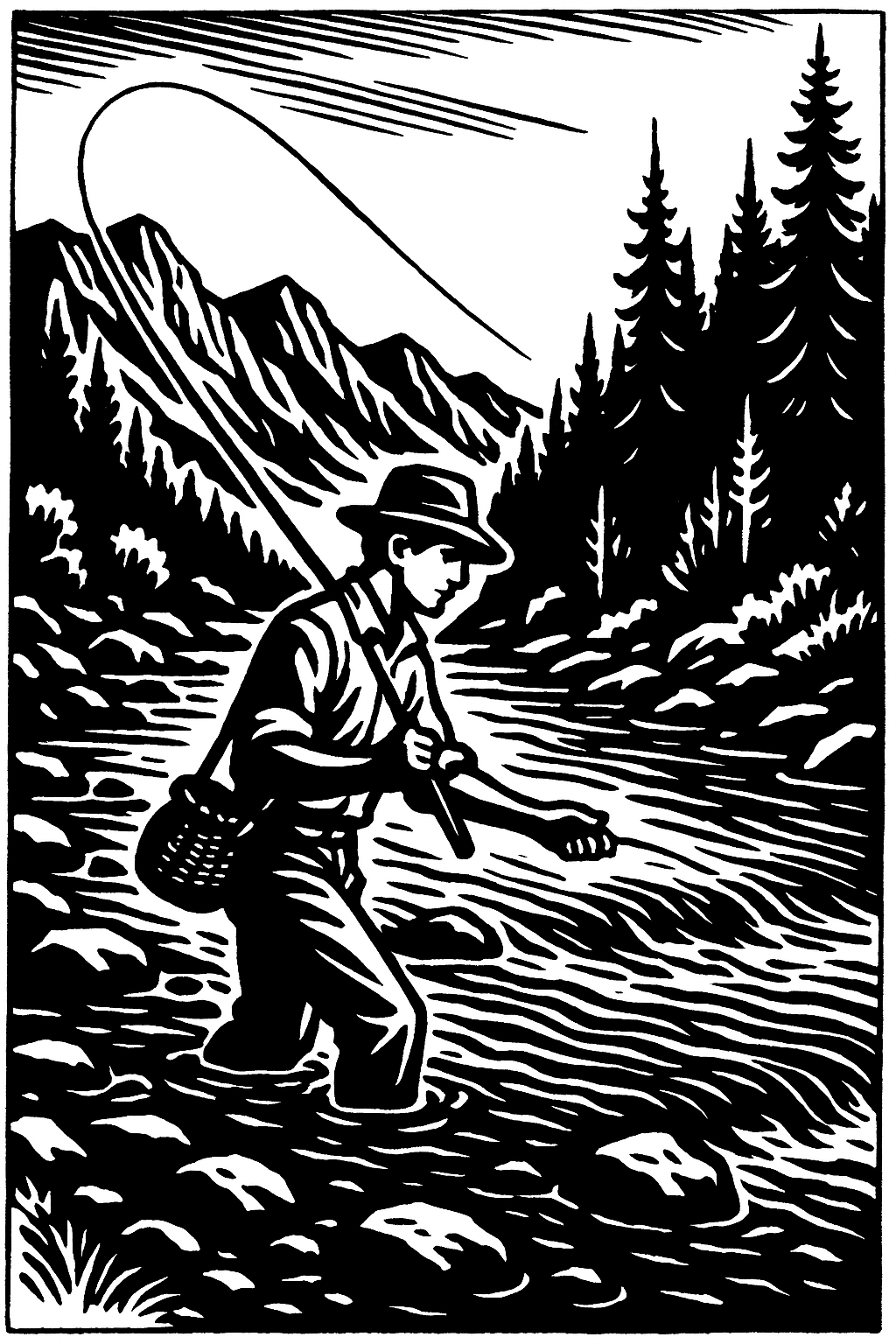
He had driven all night from Lubbock, the truck heavy with coffee fumes and the rattle of empty cans in the passenger floorboard. By dawn he crossed into New Mexico, the Sangre de Cristos rising blue and sharp before him like the bones of the earth exposed. The boy’s name was Eli. He was twenty-three, lean, and quiet the way young men are who have spent too much time thinking about what to do next and not enough time doing it.
He came for the trout. That was what he told himself. But it was more than that, and he knew it. He came for something that had no words a thing he had lost without realizing he ever had it.
By midmorning he parked near a narrow stream that curved through aspen and pine, water so clear it seemed more air than liquid. The sound of it filled the valley like breath. He tied a #16 Adams to his tippet, hands stiff in the mountain chill. He moved upstream, stepping carefully over slick stones, casting against the current, the line unrolling with a clean whisper through the cool air.
He had learned to fish from his father on a muddy Texas creek, the kind that barely moved except in spring floods. His father was gone now , heart took him quick, but Eli still heard his voice when he fished. Let it drift, son. Don’t force it.
He cast again. The fly touched down soft as dust. A shadow moved beneath it, flashed, and was gone. He smiled, just a little.
The day stretched thin and long. The sun climbed high, then tilted west. He caught small browns strong, nervous fish and let them go, each one leaving a brief tremor of life in his fingers. Around him, the wind stirred the pines, the smell of resin and cold stone mixing with the smoke from his little fire. He ate jerky and a heel of bread.
In the afternoon he followed the stream into a narrow canyon where the cliffs rose straight and red. The water deepened and slowed into pools. He moved with the patience of prayer. Then, in the far pool under a fallen pine, he saw it, a shape long as his arm, silver and dark, holding steady in the current.
He felt his pulse quicken. He stripped line, false cast, and sent the fly arcing high. It landed upstream and drifted perfectly. The trout moved, slow as fate, and took it.
The line tightened.
The fish ran downstream, strong as a rope pulled by God Himself. Eli stumbled, heart hammering, line slicing the water. He let it run, then lifted, felt the deep pulsing weight through the rod. He spoke aloud, though no one was there. “Easy now. Easy.”
The fight went on. His arm ached. The fish leapt once, sun flashing off its back, then dove deep again. The reel screamed. He thought of his father, the way the old man used to fight fish, steady and calm and tried to be that way.
At last the trout rolled near the shallows, beaten but not broken. Eli reached down, hands shaking, and cradled it in the current. It was beautiful speckled gold, the jaw scarred from an old hook. A survivor.
He could have kept it. Measured it, photographed it, made something of it. But he didn’t. He held it a moment longer, feeling its life thrum through the cold water into his palms, and then he let it go.
He sat there a long time, watching the ripples fade. The mountains turned purple with evening. He was tired, but it was a good tired, the kind that made him feel older and younger all at once.
He broke camp in the dark, the stream still whispering in the rocks. Driving back down the narrow road, he rolled down the window and let the night air pour in, cool and wild and filled with stars.
He thought maybe his father would have been proud. But that wasn’t quite it. What mattered was that for a few hours in a high mountain stream, he had found again the quiet place where effort and grace become the same thing.
He smiled once, small and real.
Tomorrow he would drive home.
But tonight, he let the wind rush through the cab, and the sound of the river faint now, fading behind him stayed in his ears like a heartbeat.
NOTE: This story was written by artificial intelligence and is inspired by the tone and themes of Ernest Hemingway’s “The Old Man and the Sea”. It is an original work of Ai fiction and should not be interpreted as a lost or authentic work by Hemingway, nor as being affiliated with or endorsed by the author’s estate.
Leadership Development in one sentence
Jesus called his first apostles by saying: “Follow Me, and I will make you become fishers of men.” (Mark 1:14 NASB). Encapsulated within this sentence is a perfect leadership development model.
Foremost in His development model for Simon Peter and Andrew was the call to both physically follow Him and to emulate His teachings and example (Jews like Peter and Andrew understood that to follow a Rabbi was to emulate and learn from him). Like Jesus, leaders are called to model the behavior of a leader disciple for those developing in their faith to emulate.
Second in Jesus’ development model is the assignment of responsibility and goals. Jesus took upon Himself the responsibility of developing His apostles into the Spiritual leaders when he said, “I will.” His promise was to make them become leaders. Some people are born with some physical and mental traits of a leader, but no one is born with a complete set of leadership traits (who a leader is) and skills (what a leader does). Every single person must “become” or develop into a leader.
Finally, Jesus called his apostles to be “fishers of men (people).” The fishermen who heard this word picture understood Jesus was calling them to become a leader who could “catch” or influence people to the gospel in His name. This is the essence of leadership, influencing people toward a higher goal.
Spiritual leaders in the church are responsible for finding and calling future generations of leaders. A responsibility that extends to purposefully maturing young leaders through mentorship and the modeling of strong traits and skills for them to emulate. Echoing the words of Jesus, leaders in the church must say to potential future leaders, “Follow my example and I will make you a leader of people.”
Making Decisions is the Essence of Leadership
““When you come right down to it, leadership is, of course, being exerted all the time in the capacity of boosting morale, confidence and all that, but leadership is most noticeable when tough decisions finally have to be made. This is the time when you get conflicting advice and urgent advice of every kind. Now this is the kind of leadership that’s often concealed from the public.… But making decisions is of the essence in leadership—that is, handling large problems whether or not you are at war or at peace. When you make these decisions it is not done with any reaching for the dramatic. It is almost everyday and commonplace. You reach a conclusion based upon the facts as you see them, the evaluations of the several factors as you see them, the relationship of one fact to another, and, above all, your convictions as to the capacity of different individuals to fit into these different places. You come to a decision after you’ve taken all these things into consideration. Then you decide and say, ‘That’s what we’ll do.’” General Dwight D. Eisenhower
— American Generalship: Character Is Everything: The Art of Command by Edgar Puryear
Adaptive Situational Awareness
“A leader is only as effective as their capability to recognize and understand their surroundings, whether it is a crisis, a team, or a project. I always begin with promoting adaptive situational awareness, meaning a leader has to have systems that provide them accurate and timely information, is accepting of bad news, and is willing to pivot in light of changing circumstances. In so many cases in homeland security or crisis management, it is the failure to capture fully the magnitude or the situation that leads to consequences that could have been avoided.” Juliette Kayyem, Senior Belfer Lecturer in International Security at Harvard’s Kennedy School of Government,
Self-Leadership
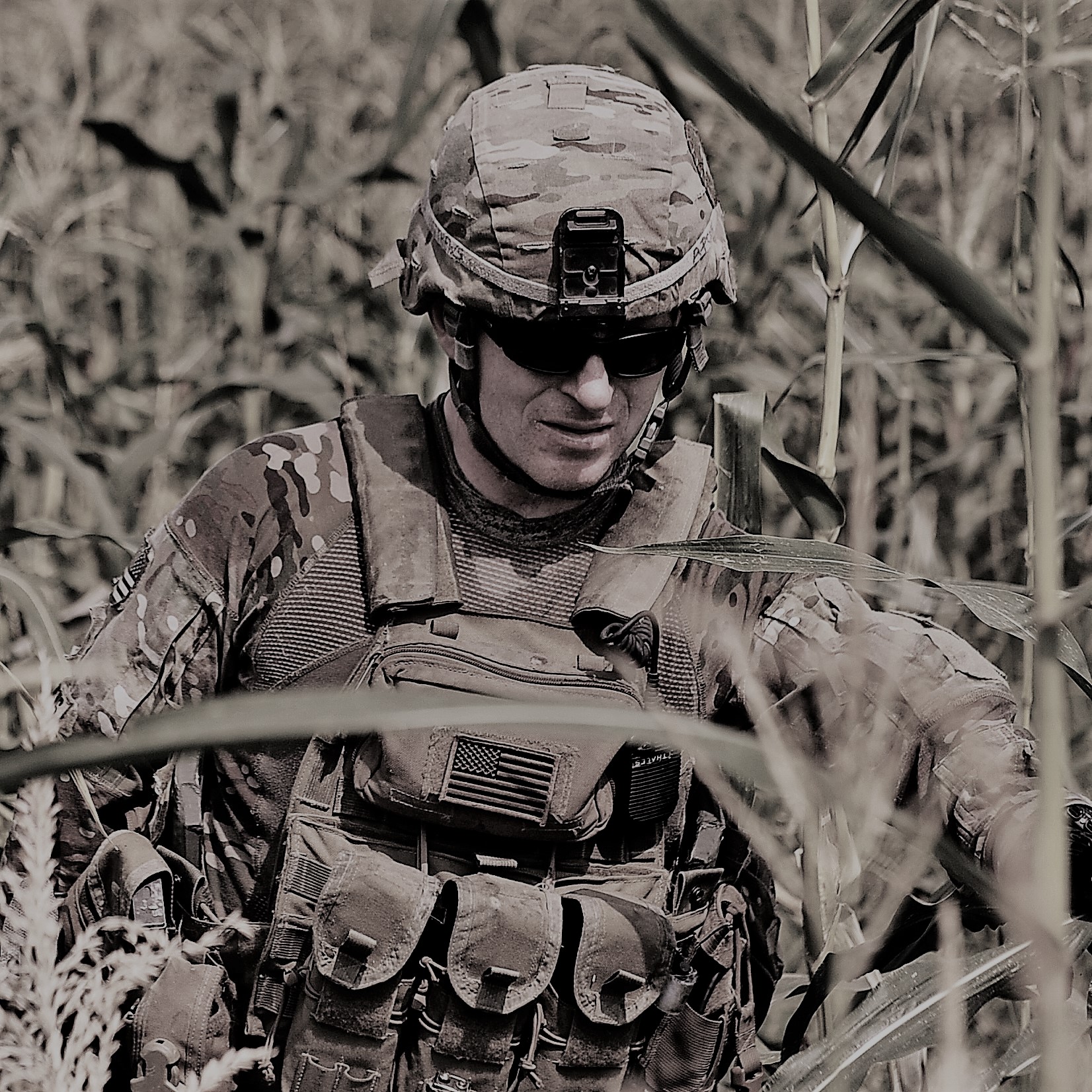
Without mature self-leadership competencies, leaders face an increasingly unsustainable environment. The stress of growing job complexity, difficult decisions, limited time, information overload, the high stakes of negative consequences (this list goes on for a while) combined with the attention required to maintain family, friends, church, hobbies (this list also goes on) can be impossible to manage. UNLESS you understand that self-leadership comes before all other levels of leadership (direct-, organizational-, strategic-) and have ingrained the self-leadership disciplines you need to sustain the leadership environment.
Self-Leadership is a continual cognitive discipline that strengthens the spiritual core and builds mental, physical, and emotional wellness to maximize performance and happiness* to reach personal and organizational objectives.
*The Stoics defined happiness (eudaimonia) more deeply as “flourishing” and “living in agreement with your purpose (nature).” Contrast with “hapless”