- Allowing too much complacency
- Failing to create a sufficiently powerful guiding coalition
- Underestimating the power of vision
- Under communicating the vision by a factor of 10 (or 100 or even 1,000)
- Failure to remove obstacles to the vision
- Not systematically planning for and creating short-term wins
- Declaring victory too soon
- Failure to anchor change in the organizations culture (more…)
Making a Change at Church: Eight (not so) Simple Steps
In a previous post I quoted John Maxell who observed that older and “insecure leaders view change as a threat rather than an opportunity. ” But what if you have to change.
Many small churches are facing declining membership because their traditions have not changed in decades. The prevailing belief is worship traditions are Biblical and any deviation must certainly be a sin. Even though largely attracted to the spiritual (review the popular movies today) , younger generations are increasingly turned off by what they see as rigid and irrelevant. (more…)
Change: Threat or Opportunity?
Nobel Prize-winning author John Steinbeck asserted, ‘It is the nature of man as he grows older to protect against change, particularly change for the better.’ By its very nature, empowerment brings constant change in that it encourages people to grow and innovate. Change is the price of progress. Insecure leaders view change as a threat rather than an opportunity. – John Maxwell
New Moment Resolutions: Why New Year’s Resolutions are Irrelevant
 NOTE: Originally posted on thepracticalCHRISTian.net
The New Year is a time of renewal reminiscent of the fresh starts each school year brought when we were children. Starting fresh is intoxicating to those of us encumbered with a litany of bad habits and regrets we would like to leave behind. Overwhelmingly those who resolve to leave baggage behind each new year fail. Most can make it a couple of weeks, a few for a couple of months, and a small minority past six months.
As the habits and regrets each day mount, we trod along hoping for another fresh start fix. Like junkies we crave a fix and decide to move, or change jobs or one is forced upon us through the tragedy of divorce, fire, or death. With each start we once again resolve to change only to fail again. Our hope for the next new year renews and the cycle repeats.
There has to be a better way. (more…)
Bible Class Audio: Sermon on the Mount
December 26, 2010 “The House Built on a Rock: The Church”
December 19, 2010 “O Lord Won’t You Buy Me a Mercedes Benz?”
December 12, 2010 “Daily Bread?” Notes
December 5, 2010 “The Lord’s Prayer” Notes
November 28, 2010 “Purer Motives” Notes
November 21, 2010 “Be Perfect as Your Heavenly Father is Perfect” Notes
September 12, 2010 “Salt of the Earth and Light of the World (Part 4) Notes
September 5, 2010 “Salt of the Earth and Light of the World (Part 3) Notes
August 29, 2010 “Salt of the Earth and Light of the World (Part 2) Notes
August 22, 2010 “Salt of the Earth and Light of the World(Part 1) Notes
August 15, 2010 “The Blessings of Jesus (Remix)”
August 8, 2010 “The Blessings of Jesus (Part 2)” Notes
August 1, 2010 “The Blessings of Jesus (Part 1)” Notes
July 25, 2010 Notes
June 20, 2010 “Introduction to the Sermon on the Mount (Part II) Notes
June 13, 2010 “Introduction to the Sermon on the Mount” Notes
May 23, 2010 “Kingdom of God (Part 2) Notes
Leading from the Outside
Unless you are prepared to see things differently and go against the current, you are unlikely to accomplish anything truly important. And to go against the current, you have to be something of an outsider, living on the edge, a member of a small but vibrant counterculture. You must free yourself from habitual ways of looking at things, cultivate an independent and questioning perspective, and be ready to embrace alternative and counterintuitive points of view.
Dove Frohman in Leadership the Hard Way: Why Leadership Can’t Be Taught – And How You Can Learn It Anyway (J-B Warren Bennis Series)

Jesus or Christ
Christ was predominately used in books until the turn of the century. Since the 1980s the use of Jesus has taken dominated. Overall the use of both has dropped including use of the word “Gospel.” Data built using Google Ngram 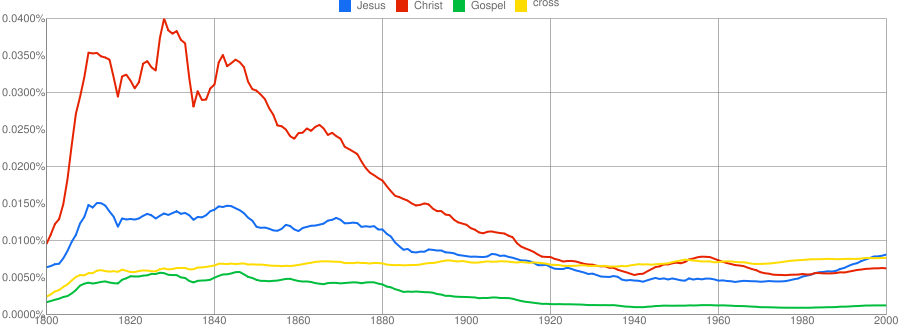
Christ vs Money

Source: Google Ngram data link here
Management Since 1800
I’m a proponent of leadership over management as the primary course of study to improve one’s ability to influence people. Management, however, seems to have reigned as a subject in books since the 1800s. The google Ngram below charts the usage of the keywords “manager,” “leader,” “management”, and “leadership” in books since 1800.
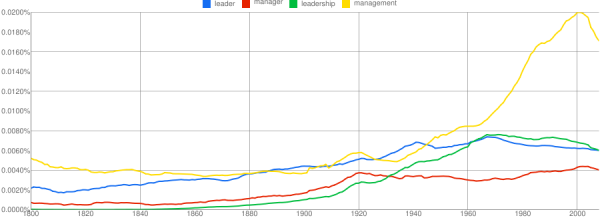
I notice a couple of interesting things about these trends:
- Leadership subjects did not appear until the mid 1800s (perhaps as a result of the American Civil War)
- Management subjects decreased during the America’s Great Depression
- Management subjects skyrocketed during 1970-1990 (the rise in the economies of industrialized countries)
- All of the keywords dropped in usage after 2001 (Influenced by the attacks on September 11?)
Heaven vs hell
Make your own conclusions on the Google Ngram of the following book subjects since 1800

